
If you listen to the Huberman Lab podcast, or read his recent book Protocols, you've probably heard Andrew Huberman make the case for red light. Better energy, healthier skin, even sharper eyesight. It's a compelling pitch, and it's sent a lot of people searching for red light therapy near them.
Here's where it gets confusing. Red light therapy and infrared saunas sound like close cousins, and plenty of marketing blurs them together. They both involve light, and they both get talked about in recovery circles. But they do very different things in your body. If you're in Peterborough and trying to figure out which one is worth your time (or whether you need both), this guide will clear it up.
Why Everyone's Talking About Red Light Therapy
A lot of the current buzz traces back to research from Glen Jeffery, a neuroscientist at University College London who studies how light affects our cells. Huberman has leaned on this work heavily, and the core idea is simple: certain wavelengths of red light appear to support the health of your mitochondria, the tiny structures in your cells that produce energy.
Mitochondria tend to become less efficient as we age. In animal research, red light exposure has been linked to slowing some of that age-related decline in how organs and tissues function. Human research on this is still early, but a few studies are genuinely interesting (more on those below).
One more point from this research: some of the most striking effects seem to come from exposing a large area of the body to long-wavelength light, rather than spot-treating one small patch of skin, so larger or whole-body red light panels seem to work the best.
Red, Near-Infrared, Far-Infrared: A Plain-Language Guide
All three of these are forms of light. What separates them is wavelength, and wavelength changes what the light does when it reaches you.
Visible red light (roughly 630 to 700 nanometres): The deep red glow you can see. It's absorbed in the outer layers of skin and tissue, and it's the main wavelength used in red light therapy panels.
Near-infrared light (roughly 700 to 1,100 nanometres): Just past what your eyes can see. It travels deeper into tissue than visible red, and many red light devices combine both.
Far-infrared light (much longer wavelengths): You can't see it, but you can feel it, because your body experiences it as heat. This is what most infrared saunas, including ours, primarily use.
Red and near-infrared light work mainly by interacting with your cells, while far-infrared works mainly by warming you up.
What Red Light Therapy May Do
Most of the mitochondrial effects and the benefits that come from red light therapy are grouped into three buckets.
Here's what the research looks like for each.
Metabolic Effects
This is one of the more surprising findings. In a 2024 study from Jeffery's lab, 30 healthy adults were split into two groups. Half had 15 minutes of 670 nm red light shone on their backs before drinking a glucose drink, and half didn't. The red light group's blood sugar rose noticeably less, with glucose levels about 27% lower afterwards and peak spikes about 7.5% lower.
The researchers believe the light nudged mitochondria to produce more energy (in the form of ATP), which meant cells used up more glucose. It's a small study in healthy people, so it doesn't tell us how this plays out for anyone managing blood sugar, but it's a fascinating signal.
Skin Effects
Skin is where red light therapy has the longest track record. Many people use it to:
Help reduce acne
Support wound healing
Improve overall skin tone and texture
This is why you'll see red light in so many dermatology offices and skin clinics.
Eyesight Effects
In a 2021 study, people aged 34 to 70 looked at deep red light for three minutes in the morning. Three hours later, their colour contrast vision had improved by about 17% on average, and the benefit seemed to last around a week. Interestingly, the same exposure in the afternoon didn't do anything.
It's an early study with 20 participants, so treat it as promising, not proven. And please don't start staring into random red light devices at home. If eye health is your interest, talk to your optometrist first.
What an Infrared Sauna Does
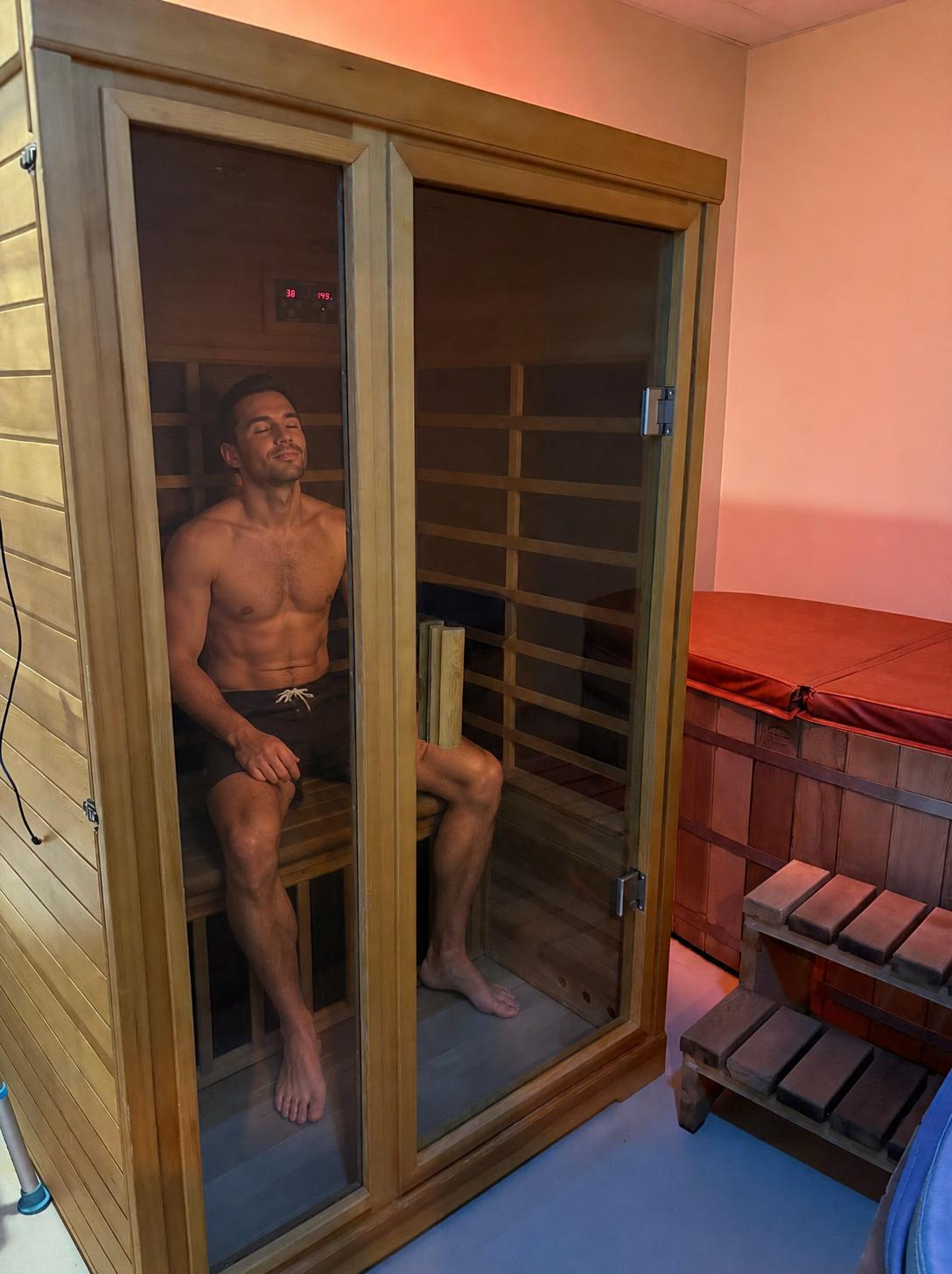
An infrared sauna is all about heat. Our sauna at Flow Spa is a two-person far infrared sauna with ceramic heaters. Instead of heating the air to very high temperatures like a traditional Finnish sauna (often 185°F and up), it warms your body more directly at a gentler temperature, closer to 150°F.
That means you can stay in comfortably, breathe easily, and still work up a real sweat. Many people find a regular infrared sauna session helps with:
Relaxation and stress relief: Heat gives your nervous system a clear signal to slow down.
Muscle recovery: Warmth can ease stiffness after training or a long day at a desk.
Circulation: Your heart rate rises and blood vessels open as your body works to cool itself.
A mental reset: Quiet, warm, no notifications. Sometimes that's the whole point.
It also pairs beautifully with the cold plunge. Alternating between the two is called contrast therapy, and it's one of the most popular ways our regulars use the space. You can read more on our infrared sauna page or in our earlier post on the benefits of infrared sauna.
Infrared Sauna vs Red Light Therapy: Where They Overlap (and Where They Don't)
Here's the comparison that’ll help you decide what’s right for you.
Where they differ:
How they work: Red light therapy delivers specific wavelengths to your skin and tissue. A far infrared sauna delivers heat to your whole body.
What you feel: Red light panels feel like almost nothing. A sauna feels warm, sweaty, and deeply relaxing.
What they're best for: Red light is targeted, mainly for skin and cellular health. The sauna is whole-body, mainly for recovery, relaxation, and stress relief.
Where they overlap:
Both fall under the broad umbrella of light-based wellness, which is why they get lumped together.
Some saunas are sold as "full spectrum" and include near-infrared emitters, which can deliver a bit of what red light panels do. A far infrared sauna like ours doesn't, so think of it as a heat tool rather than a light therapy tool.
Both may support recovery, just through different routes.
So if you've been hoping a sauna session would double as red light therapy, it won't. But that doesn't make it any less useful. They're simply different tools for different jobs.
Which One Is Right for You?
A few simple questions can point you in the right direction:
Are you mainly interested in skin health or the specific findings Huberman talks about? Red light therapy is the closer match.
Do you want to unwind, recover from training, or reset after a stressful week? The infrared sauna is your tool.
Want something that pushes your body and mind a little more? Try contrast therapy: sauna, then cold plunge, then repeat.
Plenty of people use both, at different times, for different reasons. There's no rule that says you have to pick one forever.
Frequently Asked Questions
Does Flow Spa offer red light therapy?
Not at the moment. At Flow Spa in Peterborough, Ontario, we focus on far infrared sauna, cold plunge, contrast therapy, float therapy, Normatec compression, and massage. If red light is your specific goal, look for a provider with a dedicated red light panel or bed.
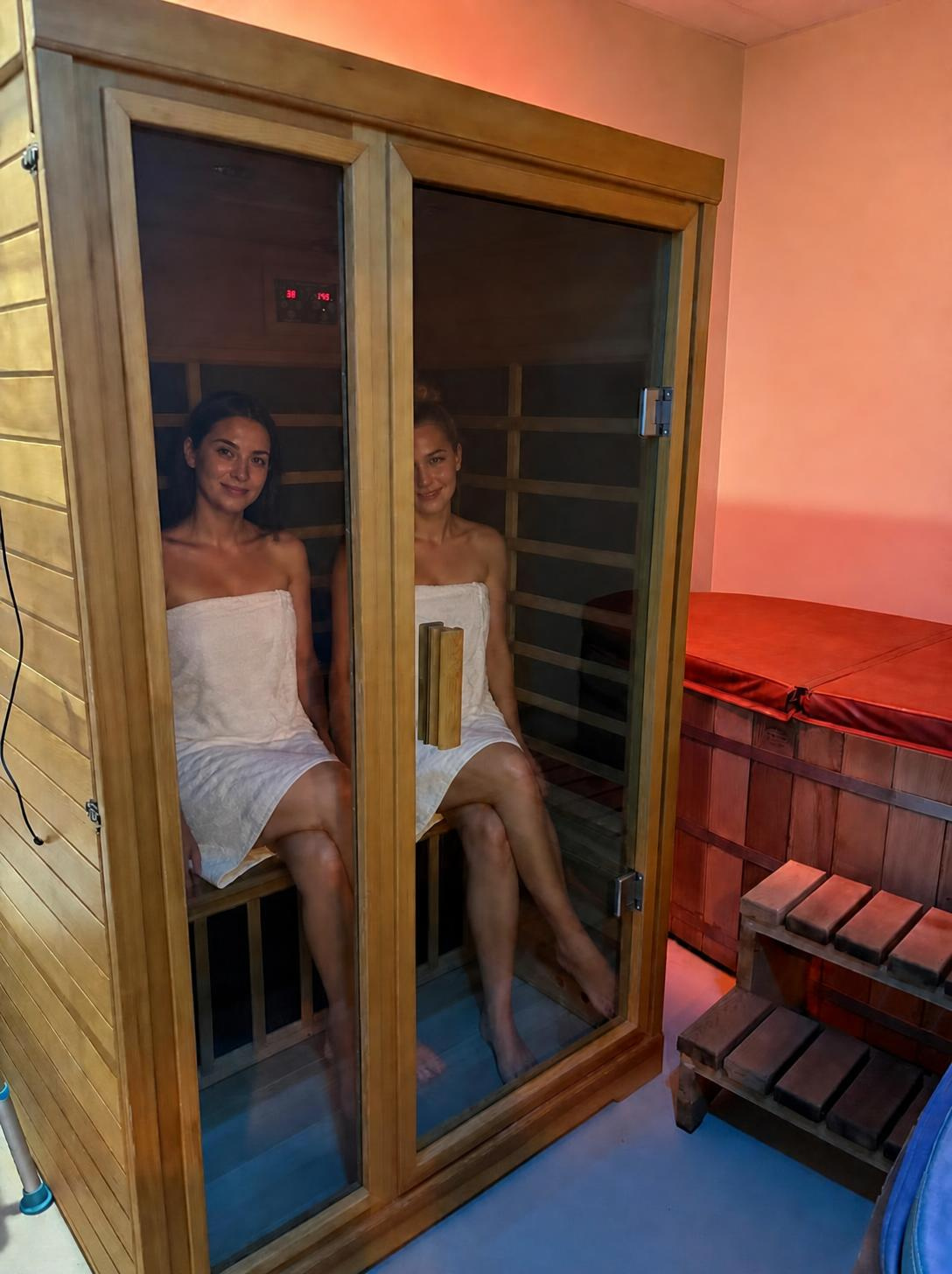
Our infrared sauna is big enough to bring a friend and share in the relaxing experience together.
Is an infrared sauna the same as red light therapy?
No. A far infrared sauna works through heat, while red light therapy uses specific visible red and near-infrared wavelengths that interact with your cells. They're related on the light spectrum, but they do different things.
Can I get red light benefits from an infrared sauna?
Only if the sauna has near-infrared or red light emitters, and even then the dose is usually much lower than a dedicated device. Our sauna is far infrared, so its benefits come from heat.
How long is an infrared sauna session?
Most people find 30 minutes comfortable and ideal for each session. If you're new to it, you can get out halfway through to cool off or open the door for a few seconds to cool it down and see how you feel.
Can I combine the infrared sauna with a cold plunge?
Yes, and it's one of our favourite combinations. Alternating hot and cold is known as contrast therapy, and many people find it leaves them feeling energized and clear-headed.
Is the infrared sauna included in a membership?
Yes. Our Unlimited Membership covers sauna and contrast options, along with floats and Normatec, so you can make heat a regular part of your routine. We also have package options available if you just want to focus on the sauna sessions.
Red light therapy is having a moment, and some of the research behind it is genuinely exciting. But if what you're really after is deep heat, a good sweat, and a reset for your body and nervous system, the infrared sauna is the tool for the job.
If you're in Peterborough and want to make it a habit, take a look at our Unlimited Membership, or simply book a sauna session and see how you feel afterwards.