I've worn a lot of fitness trackers over the years. Whoop, an Oura ring, different Apple Watches, and lately the Amazfit Helio Strap. Some of them helped me change my habits for real. Others mostly gave me a number to feel good or bad about first thing in the morning. Screenless wearables in particular are exploding in popularity with Whoop leading the way still but competitors from Garmin, Polar, Google, (and likely Apple soon).
Lots of the people who come into Flow Spa for a float, a sauna and cold plunge session, or a massage are wearing one of these devices too. They're curious about what their recovery or sleep score means, whether their HRV is "good," and whether what they're doing to recover is working.
So here's my take on what wearables are good for, where they fall short, and how to use your data to make better choices about training and recovery.
What wearables are actually good at
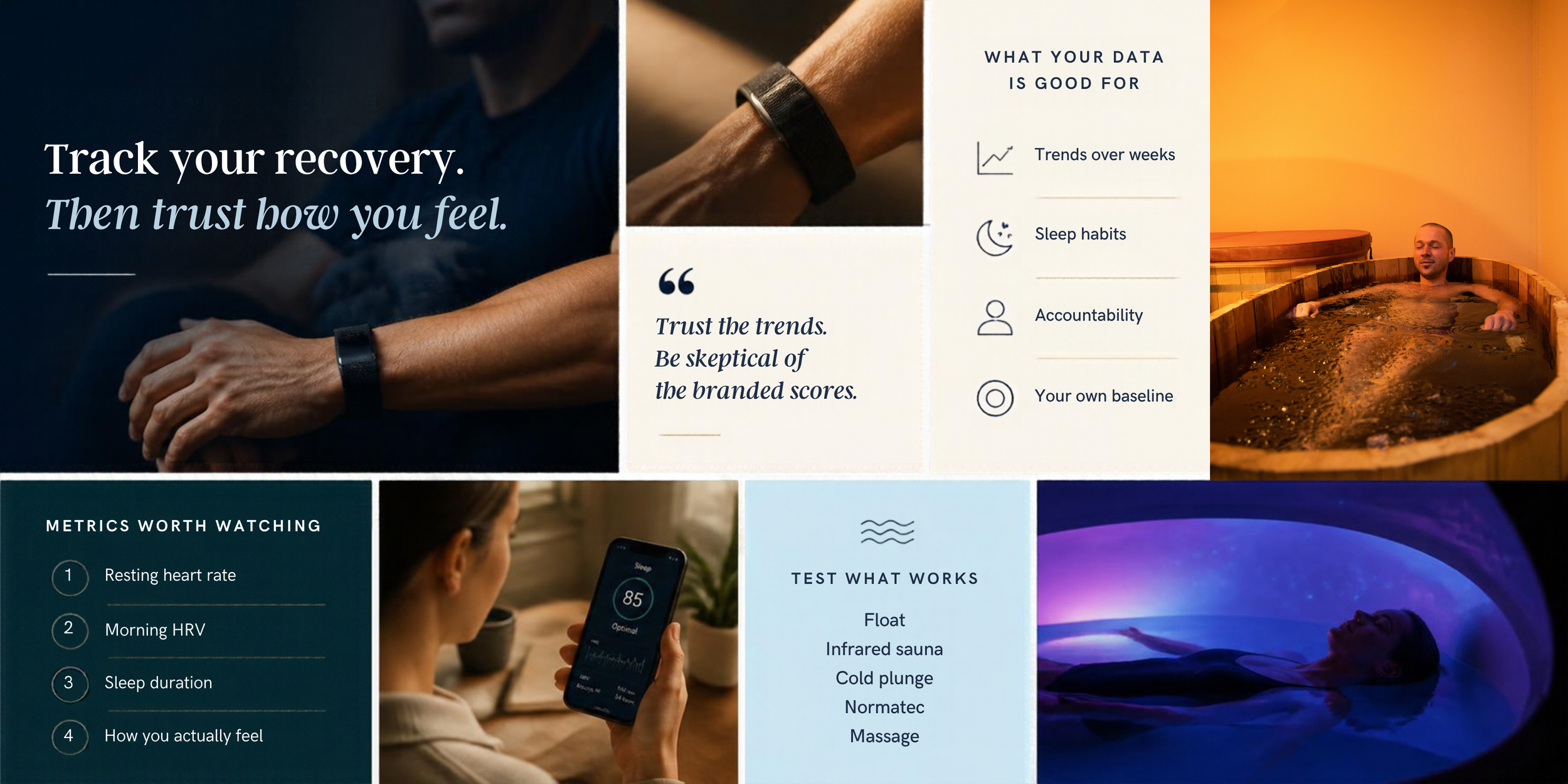
Spotting trends over time. A wearable is at its best when you look at weeks, not days. Resting heart rate creeping up over a week of bad sleep and hard training. HRV slowly climbing as your fitness improves. Sleep getting more consistent once you stop scrolling in bed. Trends like these are real and worth acting on.
Sleep habits. For most people, sleep tracking is the most useful thing a wearable does. It won't be lab-accurate, but it's good enough to show you how late meals, alcohol, screens, or a late workout change your night. Just don't obsess over every stage of every night. Use it to inform you of your optimal sleep window and the ideal amount of sleep you need to recover well based on your stress and exertion.
Accountability and motivation. Being able to see your effort pays off. Wearing a device you check every day keeps health on your mind, and for lots of people that alone makes a difference in reinforcing the progress you’re making towards your goals.
Where they fall short
Branded scores. Whoop Age, readiness scores, strain scores, Garmin's Body Battery. These can nudge you in the right direction, but they're proprietary formulas built on top of the raw data. Most days they sit in the same range, and unless something changes a lot, they rarely tell you anything you didn't already feel. Use them as a guide, not a verdict.
All-day HRV averages. Your stress levels and nervous system swing up and down all day, so an algorithm averaging HRV across the whole day is a noisy number. A consistent morning reading, taken at the same time and in the same position, gives you a much cleaner signal. That’s how another type of wearable, the Morpheus chest strap does it. Think of HRV readings like weigh-ins: same time, same conditions, and watch the trend.
Heart rate during hard efforts. Wrist and optical sensors are fine for general wellness, but they struggle with intervals and other high-intensity work. If precise heart rate or HRV matters for your training, a chest strap is still the gold standard. While this is the argument for the superiority of chest straps for heart rate data, I think that most devices are so much better these days that unless you’re an elite athlete, you’ll never notice the difference in your heart rate data. At most your average heart rate and minimum and maximum over your entire workout may be off by 1 bpm.
Calories burned. This one surprised me. Different devices give wildly different calorie estimates. When I switched to the Helio Strap, it was a lot less generous with calorie burn than what I'd been using, and that may explain why my weight loss stalled for a while going off of what I assume my baseline was from the Apple Watch data. I haven’t been in the deficit I thought I was for months. Treat calorie burn as a rough estimate and let your body weight results over a few weeks tell you the truth.
How to use your data to make better recovery decisions
Your data is only useful if it changes what you do. Here's the simple approach I use:
Pick a few metrics and ignore the rest. Resting heart rate, a consistent morning HRV reading, and sleep duration cover most of what you need.
Compare against your own baseline, not anyone else's. A "good" HRV is whatever's normal for you. Look for meaningful changes from your normal, not daily blips. Also, don’t try to compare across different wearables you have. The algorithms are often different.
Check your data against how you feel. If your score says you're recovered but your legs feel like cement, believe your legs. Wearables are best at sharpening your sense of your own body, not replacing it.
Treat a downward trend as a signal to recover on purpose. Several days of rising resting heart rate and falling HRV is a good time to swap a hard session for an easy one, prioritize sleep, and book some recovery time.
Test what works for you. This is where wearables get fun. Track your sleep and morning HRV after a float, a sauna session, or a massage, and compare it to your normal. You'll learn which recovery tools actually move the needle for your body.
The tracker I'm testing: Amazfit Helio Strap
I've been testing the Amazfit Helio Strap, and I'm putting together a full review for our YouTube channel.
Here's the short version of what I’ve seen from it so far.
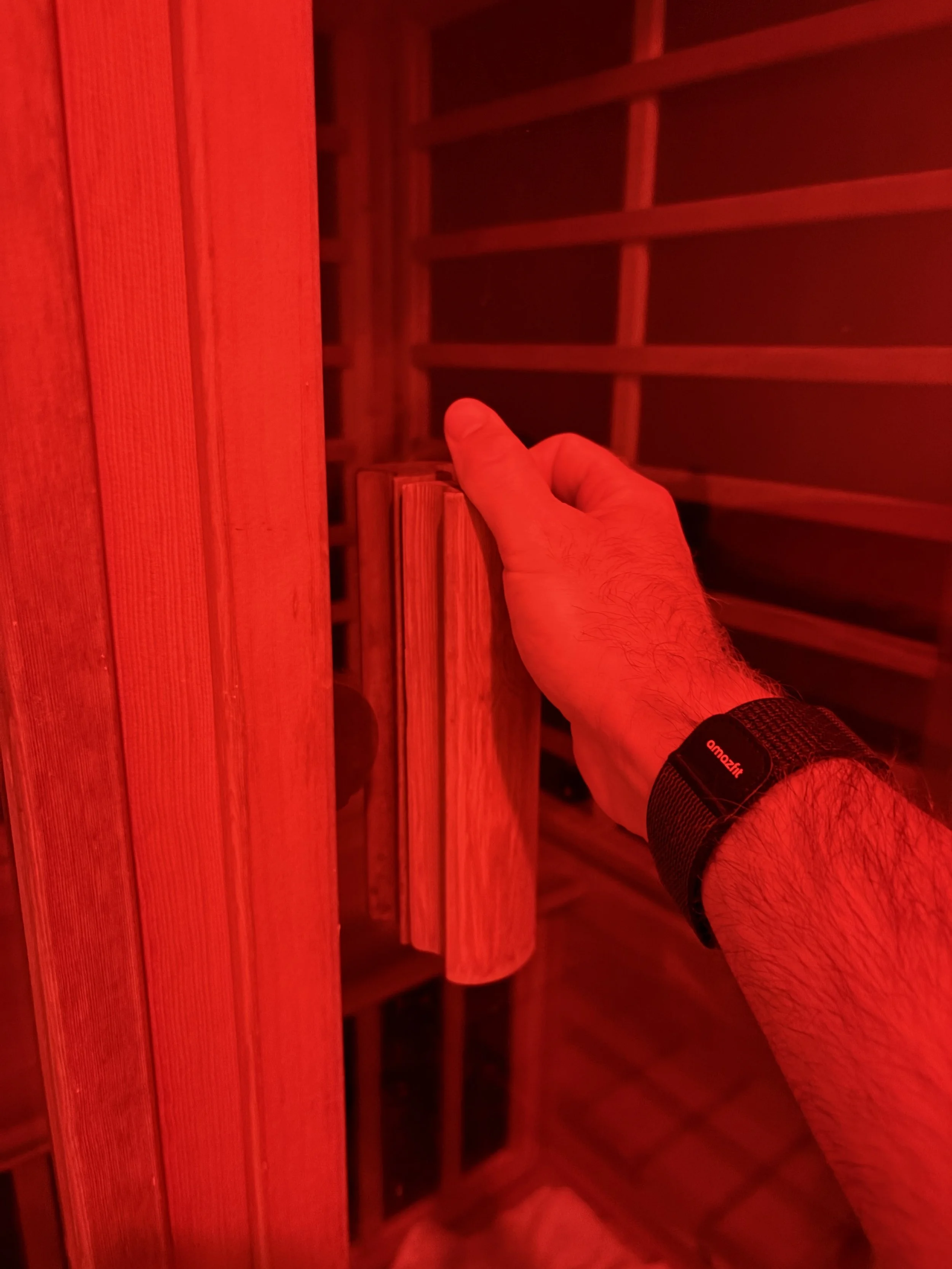
The Amazfit Helio Strap is very unobtrusive and easy to wear without disturbing your peace during your recovery sessions in the sauna, cold plunge, or float tank.
The Helio Strap is a screenless band, just like the Whoop, that tracks heart rate, HRV, sleep, and activity. A lot of people seem to think it’s a product from Amazon, but it’s not. Amazfit is a completely different company that’s differentiating themselves by being the official Hyrox partner. The big difference with Amazfit: they’re focused on hybrid athletes and are the official partner of Hyrox, and best of all, you don't need a subscription to see your data. After years of paying monthly to access my own health data, that was the main reason I tried it. Most of the big names in wearables charge a monthly fee, and it's refreshing to see a brand compete with them without charging a premium.
What I like so far:
Their app, called Zepp, is clean and easy for anyone to understand. Lots of wearable dashboards have become cluttered. Zepp shows you what matters and explains what you're looking at, which is great if you're new to reading your own data. It also is very customizable to show, rearrange, and hide anything you want.
A built-in food log. Most wearables don't have one, or put it behind a subscription. You can set it to adjust your energy targets based on how active you were that day, which helps if you train a lot and want to make sure you're eating enough to recover. It also has a really useful feature where you just take a photo of your meal and it can very accurately tell you what you ate and give you the macro and calorie breakdown. Gone are the days of food scales and measuring cups.
It plays well with others. It syncs with Apple Health and Google Health, so if you'd rather use a different macro tracker, your data still ends up in one place.
Your data isn't locked away. You can export it and use it however you want, including third-party tools that connect it to the AI apps you already use.
It fits Whoop clothing. If you have Whoop boxers or other gear from a previous Whoop, the Helio Strap fits, stays put, and tracks heart rate just as well.
Sleep data is good. Sleeping with a wrist band is more comfortable than a bulky watch and the bonus of being able to use Whoop apparel boxers means you can even have the tracker at your waist and off your wrist. The data has been on point with my Apple Watch readings and nothing seems to be far off or inconsistent. It also has sleep apnea detection, which I know newer Apple Watches include but I don’t have. This is something I really value as I used to have sleep apnea and like to monitor how well I’m breathing at night.
Multi-device pairing. If you have multiple phones or work across both iOS and Android, Amazfit makes it easy to sync with either device just by logging in. There’s no need to forget one device or re-pair the way Garmin and Apple devices force you to if changing which device you’re connected to.
Battery life. I’ve used a Whoop 4.0 and 2nd generation Oura ring and my Apple Watch is still a daily wearable for me. All of these have the battery life we’ve come to expect, with charging being required after just a day or two. I’ve worn the Helio Strap for 8 days straight without taking it off to charge and it still has 20% battery life. I think this is more like what we should come to expect of health wearables and it is the trend with newer Whoops and other devices like Garmin watches. It’s really nice to ditch that battery life anxiety for a change. You could pop it on the charger once a week, or every 8-9 days, while showering and you’d be good to go.
What to know before you buy:
GPS isn't its strength. It uses your phone's GPS, and my outdoor bike rides were noticeably off. I use a bike computer for cycling anyway, so it didn't bother me, but serious runners and cyclists should plan on another device for outdoor tracking if the accuracy of your data matters to you. Walking GPS data seems fine to me, but my cycling data has been short by close to 1000 m on some rides.
Workout and movement detection is hit or miss. Logging sets and recognizing exercises automatically wasn't great. Upper body workouts are quite good, but it misses the mark on most lower body movements. Their upgraded Helio Strap Pro has multiple sensors for more detailed position and muscle load analysis. I haven't been impressed with movement detection on any wearable to the point of counting on it, so it’s a nice feature but not essential for me.
There's an optional subscription (Zepp Aura). It mostly unlocks extra sleep features, like guided audio and relaxation tracks, plus more in-depth analysis and AI chat insights. Everything I've described above works without it.
Who it's for: anyone who wants solid insight into their sleep, recovery, and performance from a device that stays out of the way, without paying monthly to see their own data.
👉Get 10% off by ordering directly through Amazfit
👉 Check out the Amazfit Helio Strap on Amazon
My full video review is coming soon to the Flow Spa YouTube channel.
A wearable won't recover for you. What it can do is help you notice patterns, stay consistent, and figure out what helps you bounce back. Trust the trends, be skeptical of the branded scores, and always check the numbers against how you actually feel.
And if your data is telling you it's time to slow down, you know where to find us.
Disclosure: This post contains affiliate links. As an Amazon Associate, Flow Spa earns from qualifying purchases at no extra cost to you. We only recommend products we've actually tested.