Chaos happens to the local training calendar in early September.
For endurance athletes, the fall race season is suddenly weeks away, minor hockey tryouts and pre-season camps start filling the arena schedule, and the kids go back to school in the same stretch. Your training load goes up right as your free time goes down.
That squeeze and added pressure is when most people get hurt, or just fall flat with training. The work you do in the gym or on the road is only half of it; the adaptation happens in the recovery hours between sessions.
This is a look at how to protect those hours, and which recovery tools are worth your time when the calendar gets tight.
Why fall is the hardest season on an athlete's body
Fall training in Peterborough tends to stack three things at once.
Volume peaks. If you're pointed at an October race like the Toronto Waterfront Marathon on October 17-18, September is your biggest month of running. The longest runs, the hardest workouts, and the most cumulative fatigue all land in the same four weeks.
Intensity changes. Hockey players come off a summer of skills and training into full-contact tryouts and games. The tissue loading is different, and it hits hard and fast.
Sleep and schedule compress. School starts, work picks back up after summer, and the 7.5 to 8 hours you were getting in July suddenly becomes 6.5.
Together, these factors are the reason so many athletes limp into October with a nagging calf, a cranky hip, or a general sense that their legs are out of gas.
What recovery is actually doing between sessions
Training is a stress. Your body responds to that stress by rebuilding a little stronger, but only if it gets the signal and the space to do it. When stress keeps arriving, and the space never comes, you accumulate fatigue instead of fitness.
Most recovery work is aimed at two things: helping tissue clear waste and get fresh blood flow, and helping your nervous system shift out of a constant fight-or-flight state. The nervous system matters more than most athletes expect. A body stuck in high alert doesn't sleep well, doesn't digest well, and doesn't rebuild well.
Modalities like compression, heat, and cold exposure can support blood flow, perceived soreness, and relaxation. What we hear most often from athletes at Flow Spa is that they sleep better, and their legs feel fresh again the next morning.
A recovery menu for runners in marathon training
If you're deep in a fall training block, the goal is to absorb high mileage without breaking down.
A few tools fit that job well.
Normatec compression after long runs
Pulsed compression cycles pressure through your legs and hips, which many runners find helps with lymphatic drainage, heaviness, and soreness after a long effort. A 30 to 60 minute session is easy to slot in on a Saturday afternoon when you're going to be sitting anyway. Plenty of our clients bring a laptop or a book and get something done while their legs get worked on. You can see how it works on our Normatec page.
Infrared sauna on easy days
Heat is a gentle way to encourage circulation and give your nervous system a chance to downshift. Easy days and rest days are the natural place for it, rather than immediately before a hard workout. The infrared sauna also works well as a quiet 30 minutes to escape the chaos of home during back-to-school season.
Float therapy in the taper
The last two or three weeks before a race are mentally strange: less running, more time to think, and every twinge feels like a threat. Float therapy gives you a rare hour with no input at all, which a lot of runners use for visualizing race day or simply for the deepest rest they get all week. The Epsom salt and the complete unloading of the joints add to the recovery benefits provided. There's more on what a session is like on our about floating page.
For hockey players heading into tryouts and pre-season
Hockey recovery has a different shape. The loading is repeated, high-intensity, and often three or four days in a row during camps.
Contrast therapy is the one our athletes, like the Petes players, are most interested in. Alternating time in the sauna with a cold plunge and hot tub creates a strong circulatory response and, for many players, a noticeable nervous system reset. A common approach is a few rounds of several minutes hot followed by a cold plunge, always finishing in a way that leaves you feeling alert rather than shaky.
A practical note for players and parents: heavy cold exposure right after a strength session may blunt some of the adaptation you're chasing, so a lot of athletes save the plunge for game days, skill days, or standalone recovery days. On heavy lifting days, sauna and compression or float therapy are the better choices for promoting adaptation.
Massage therapy still earns its place in a hockey season, particularly for hips, groins, and mid-backs that take a beating through camp. Booking one session in the middle of a tryout stretch tends to be more useful than booking three after the season is over.
Fitting recovery into a real training week
Here's what a workable week looks like for a busy adult athlete in Peterborough.
Adjust the days to your own schedule.
Monday: easy day. Infrared sauna, 30 minutes.
Wednesday: after your hardest session, Normatec while you catch up on email or schoolwork.
Friday or Saturday: long run or game day, followed by compression, or a contrast session if you're not lifting heavy that day.
Every second or third week: a float or a massage, whichever your body is asking for.
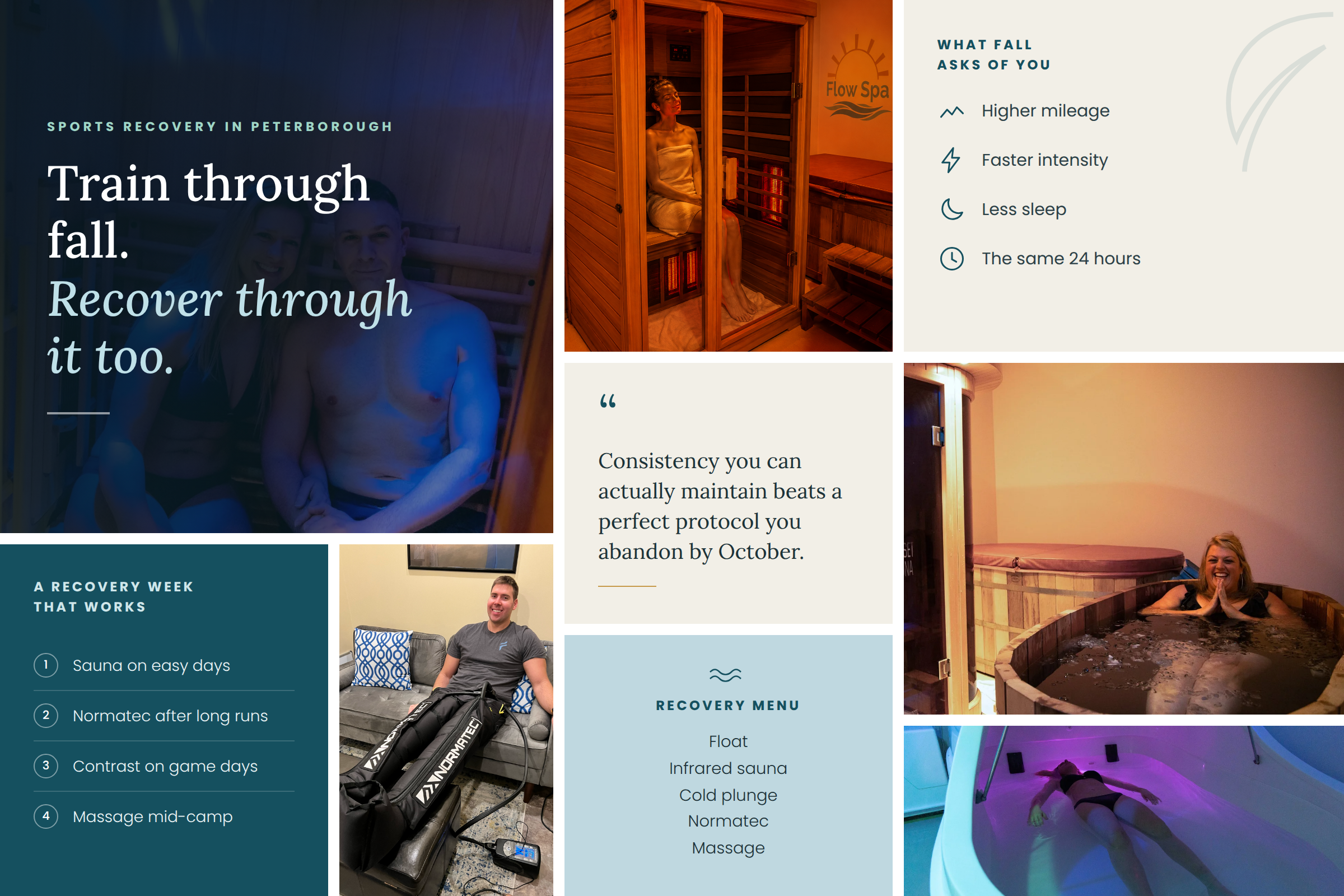
That's two or three touchpoints a week, most of them under an hour. You don't need all of it, and you don't need it every week. Consistency at a level you can actually maintain beats a perfect protocol you abandon by October.
We’ve recently created an Unlimited Membership option at Flow Spa that makes all of this possible to recover the best when you’re pushing your limits.
Frequently Asked Questions
When should I book recovery around a race or tournament?
Most athletes get the most out of a session in the 24 to 48 hours after a hard effort, when soreness is building. In the days right before a race, keep it light and familiar; race week is not the time to try a brand new modality for the first time. I’m a bit superstitious when it comes to competition performance, but you do you. If you’re looking to recover better before a race or tournament, get familiar with the recovery modalities a few weeks ahead of time.
How long is a Normatec session at Flow Spa?
Sessions run 30 to 60 minutes depending on what you book. Many people pair it with focused work or reading, since you're seated and reclined the whole time.
Is cold plunge necessary, or is sauna enough?
Sauna on its own is a legitimate recovery tool by promoting blood flow and has a similar adaptation effect to cardiovascular training. Cold plunge adds a sharper nervous system stimulus and the mental resilience piece that a lot of athletes value. If cold is genuinely unpleasant for you, contrast therapy is optional rather than required.
Can I combine services in one visit?
Yes, and a lot of people do. Sauna and cold plunge are the classic pairing. Sauna or a float followed by Normatec is another good combination, particularly after a long run.
I'm not a competitive athlete. Is sports recovery in Peterborough still for me?
Absolutely. Most of the people using these services here are recreational runners, weekend hockey players, parents keeping up with a busy fall, and people who just want their body to feel better by reducing stress. The tools don't ask what your finishing time is.
How often should I come in during a training block?
Once a week is a reasonable rhythm for most people in a heavy block, with an extra session in your highest-volume weeks. Start there and adjust based on how you feel.
Get ready for a better fall season
Your training deserves recovery that keeps up with the demands on your body. Have a look at our sports recovery services, or book a session and see how your legs feel the next morning.