In the quest for continuing and never-ending improvement, somewhere along the way, we gave rest a job to do.
We started tracking our sleep scores, timing our cold plunges to the second, and stacking recovery modalities like we're chasing a personal best in the gym. If you've ever finished a "relaxing" weekend feeling like you fell behind on your own wellness routine, you know the feeling. The thing meant to restore you became one more thing to get right.
This is the quiet trap of optimization culture, and in 2026, a lot of people are finally pushing back on it. Here at Flow Spa, we see it all the time: smart, busy people who are exhausted not just from work, but from the pressure to recover correctly.
When Recovery Becomes Another To-Do List
There's nothing wrong with wanting to feel good and perform well. The trouble starts when every restful thing comes with a target attached.
You start asking whether you floated long enough, whether your heart rate variability moved, and whether you're getting the full return on your time off. That low hum of measurement keeps a part of your brain switched on, which is the opposite of what rest is for.
Recovery isn't always supposed to be productive. Sometimes the most productive thing you can do is truly rest, with no scorecard at all.
What Your Nervous System Actually Needs
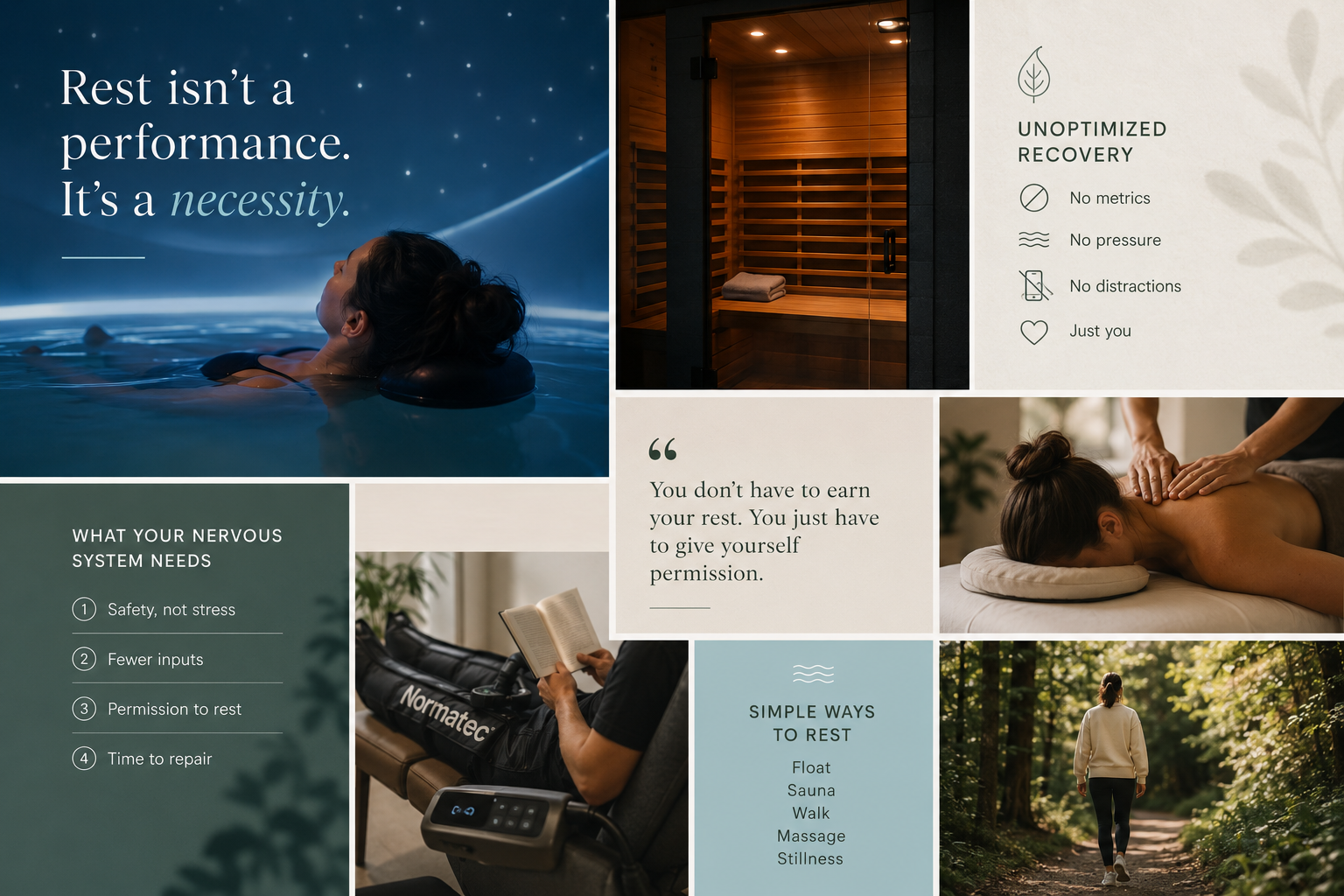
Your nervous system doesn't read your wearable the same way you do. It responds to signals of safety: low stimulation, no demands, nothing to solve. That's when it shifts out of the keyed-up "go" state and into the mode where genuine repair happens.
You can't force that shift by trying harder.
Effort is the wrong tool here. What helps is removing inputs, not adding them.
Fewer notifications, fewer decisions, fewer numbers to check.
This is why some of the oldest, simplest forms of rest still work so well. They don't ask anything of you.
Float Therapy: Rest With Nothing to Measure
This is exactly where floating shines. In a float tank, there's nothing to optimize. The water holds you, the room is quiet and dark, and for sixty minutes, there's no input to manage and no metric to chase.
Many people find that floating gives them the kind of deep mental quiet that's hard to reach any other way. Problems untangle themselves. Tight shoulders let go. You're not doing rest correctly; you're just resting. You can learn more on our about floating page, but the short version is that floating is true rest stripped down to its essentials.
That simplicity is the whole point. There's no app, no setting, no protocol to follow.
You float, you rest, and you leave clearer.
Other Ways to Rest Without Keeping Score
Floating isn't the only option for unmeasured rest.
A few others we'd gently suggest:
Infrared sauna, solo and slow. Sit in the warmth with your phone in another room. Don't time it to a recovery window; just stay until you feel ready to leave.
See our infrared sauna page for what to expect.
A walk with no distance goal. Leave the watch at home. Let your pace be whatever it wants to be.
Normatec compression as quiet time. Yes, it supports muscle recovery, and it's also a perfectly good excuse to force yourself to sit still for half an hour and do nothing else.
A massage you don't analyze afterward. Book it because your body could use it, not because you're correcting a number.
The common thread in unoptimized recovery is permission. You're allowed to rest simply because you're a human being who needs it, not because you earned it or because it'll improve a stat tomorrow.
If You're in a Season of Doing Too Much
Some seasons of life are just full. More demands, less margin, a constant sense of falling behind. In those stretches, the instinct is often to optimize harder, to squeeze more out of every recovery minute.
The kinder move is usually the opposite. Pick one simple thing that lets your nervous system stand down, and protect it. For a lot of our regulars, that anchor is a biweekly float or a quiet weekly sauna session, no goals attached.
Rest done this way tends to give back far more than rest you're busy grading.
Recovery Questions We Get Asked A Lot
Isn't tracking my recovery a good thing?
It can be useful, especially for athletes dialing in training. The issue is when measuring everything never switches off, and rest starts to feel like a test. If your recovery tools are adding stress instead of removing it, that's worth noticing.
How is float therapy different from just lying down at home?
At home there are still inputs: light, sound, your phone, the mental list of things you could be doing. A float tank removes nearly all of that sensory load at once, as well as the pressure of gravity, which many people find makes the rest much deeper. Our float page explains how it works.
How often should I float to feel the benefit?
There's no perfect number. Some people float weekly when they’re feeling the most pressure, others come monthly when life gets heavy. The honest answer is to come when you need to reset, not because a schedule says you're due.
Can I combine these without it becoming another optimization project?
Absolutely. Pairing a sauna session with a float, for example, can feel wonderful. The key is to do it because it feels good, not because you're chasing a stack. Let enjoyment be the metric.
Do I have to be into wellness for this to be worth it?
Not at all. You don't need to be an athlete or a wellness enthusiast. If you're a busy person in Peterborough who's tired and could use an hour where nothing is asked of you, that's reason enough.
You Don't Have to Earn Your Rest
If recovery has started to feel like homework, this is your permission slip to set the scorecard down. The best rest is often the kind you don't measure at all.
Curious what that feels like? Book a session at Flow Spa and come find your flow, no optimizing required.