
Do I Need To Be Able To Meditate To Float?
Many people feel hesitant around the float tank because of the idea of sensory deprivation and what you’re supposed to do for an hour with your mind.
It can be daunting to think about going into an hour of solitude to be alone with your thoughts, but many of our clients have no experience with meditation and you don’t have to either.
Let’s talk about some of the experiences of the float tank and why you don’t have to be a good meditator to reap the benefits.
An hour of peace and quiet with no distractions from your thoughts is one of the most nourishing and powerful things we can do for ourselves in today’s day and age.
The float tank is so physically relaxing because you’re supported weightlessly by the Epsom salt solution, that it helps your mind to calm down too.
This is one of the reasons that the float tank works wonders for people in pain as well as for relieving anxiety. Sometimes when your mind can’t shut off and you’re stuck worrying, it can feel like it’s impossible to calm your mind and focus on meditation. By letting yourself float peacefully with calming music or having it fade out to silence you’re able to let your body naturally guide your mind to a calmer state.
Research on float therapy has looked at what our brains do when we’re floating and has found that our brainwaves reach the slow theta state. For the most part, Theta brainwaves usually only show up under two conditions: during REM sleep and in highly experienced meditators. But because of the unique environment of the float tank is so calming and free from external stimuli, our brains are naturally able to reach this deeply rejuvenating and calm state.
Experience float therapy for yourself to see these research-backed benefits. Whether you’re booking in Peterborough at Flow Spa or your closes float centre wherever you are in the world, I’m sure you’ll have a wonderful experience.

Does The Float Tank Need To Be Sensory Deprivation?
I am watching a Livestream as my friend Josh crosses the threshold into a pitch-black shipping container which he will be locked into for 24 hours. But not only will he be locked away in complete darkness, he’s also going to run on a treadmill nonstop in a race against three other guys for a whole day. This sensory deprivation challenge was on a whole other level that no one else has ever attempted before. To say it isn’t for the faint of heart is putting it lightly.
Fortunately, float therapy doesn't have to be this way, even though it's often still referred to as a sensory deprivation tank.
While it's true that you can go with the lights and music off to completely tune out the world around you, this is not a requirement of the experience to be therapeutic. A lot of our customers who are looking for pain relief may float with the lights on or have the music play the whole session.
It’s about reaching a point of stillness in your body and your mind, and for someone who has a lot of internal distractions like a racing mind, relaxing music can be just enough to help bring about a calmer state.
We also have customers with tinnitus who also prefer to keep the music on or plug in their own device to play some audio or a podcast because it is much more relaxing for them without the ringing in their ears.
We most commonly use a playlist of relaxing sleep soundtracks to help settle you into your float. If you want to download or listen to it right now, you can do so here. Listen for yourself and even choose which track you like the most if you want to request it during your float.
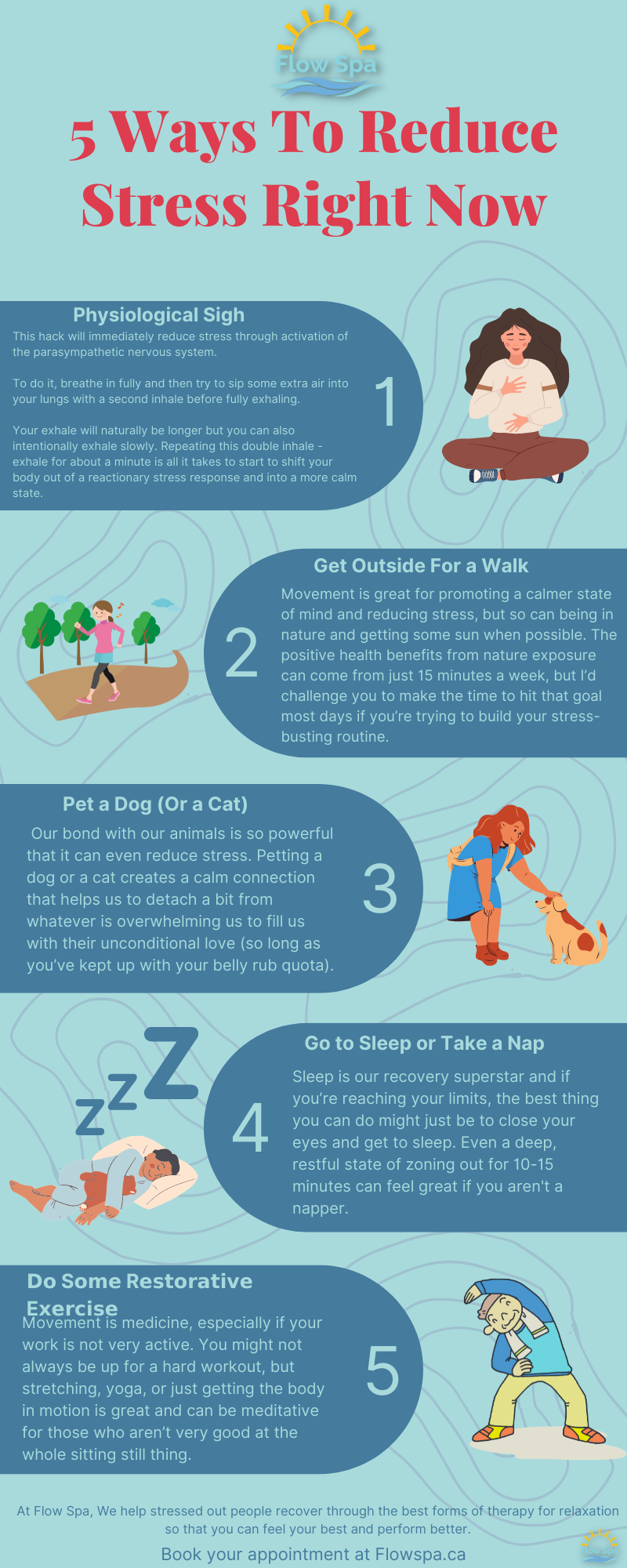
5 Ways To Reduce Stress Right Now
You don't even have to be great at meditating in order to reduce your stress right now.
You don't have to be a great meditator to live stress free. Put these five practices into place regularly to beat burnout and feel like your best self again.
Physiological sigh
This is as close to a hack as you will find for immediately reducing stress through activation of the parasympathetic nervous system.
Think about if you’ve ever caught yourself sobbing and felt like you couldn’t catch your breath. Or if you’re a steely-eyed stoic who’s never made a face, you’ve probably seen someone in a state of hyperventilation. Breathing is very rapid but shallow. And when we’re helping someone through this situation, we get them to breathe into a paper bag or breathe through pursed lips, helping to slow down their breathing.
The physiological sigh immediately activates a state of calmness in our body. You breathe in fully and then try to sip some extra air into your lungs with a second inhale before fully exhaling. Your exhale will naturally be longer but you can also consciously think to exhale slowly. Repeating this for about a minute is all it takes to start to shift your body out of a reactionary stress response and into a more calm state.
This is so powerful because it can be done anytime, anyplace to help you to slow down and regain traction. You don’t have to plop yourself onto a cushion and get situated in a lotus position with eyes closed to reduce stress.
Get outside for a walk
87.4% of excuses for getting outside for a walk are made up. And while that statistic is also made up, we really can in most circumstances organize our day and plan our time to spend even a few minutes outdoors moving at a relaxed pace. The movement alone can be great for promoting a calmer state of mind and reducing stress, but so can being in nature and getting some sun when possible.
Getting outside in nature for a walk checks off all these boxes at once but any one of them can suffice to help you to reduce stress, assuming you’re not allergic to the sun.
Research suggests that positive health benefits from nature exposure can come from just 15 minutes a week, but I’d challenge you to make the time to hit that goal most days if you’re tying to build a stress-busting routine.
Pet a dog (or a cat)
Our bond with our animals is so powerful that it can even reduce stress.
Therapy dogs and seeing them in the hospital wards serve a purpose in delivering joy.
Petting a dog or a cat creates a calm connection that helps us to detach a bit from whatever is overwhelming us to fill us with their unconditional love (so long as you’ve kept up with your belly rub quota).
This action might be a little less practical for some of us due to fears, or allergies, or just not having pets around, but it’s still a really quick way to reduce stress and feel better, so make use of it if and when you can.
Go to sleep or take a nap
Sleep is our recovery superstar and if you’re reaching your limits, the best thing you can do might just be to close your eyes and get to sleep.
Do some restorative exercise
Movement can be medicine, especially if your work is not very active or you spend much of your day seated. You might not always be up for a hard workout, but stretching, yoga, or any type of activity that gets the body in motion is great and can be meditative for those who aren’t very good at the whole sitting still thing.
Now, are you ready for the real secret? Pick just one of these things and try it out. If you’re already feeling stressed out, trying to check off more boxes isn’t going to help. Whatever sounds like something you’d like to do and can make work, do it consistently and see if it is helping you.
Have fun, get curious, and Find Your Flow

Is What We Know About Sleep True?
Is what we know about sleep true?
On average, we spend about a third of our life asleep. It’s a necessary function, and it impacts our physical and mental health. We know that a good night’s sleep makes us all feel good in the morning, but it can also help your digestive system, immune system, and even your heart.
But are we getting the sleep that we want and need?
There are so many things that prevent us from sleeping for as long as we should, and as deeply as we should. Many of us are guilty of spending hours on our phones before bed - mindlessly scrolling through social media, stimulates the brain, making it harder to fall asleep. The brain can’t just turn off like a switch, it needs to unwind and our habits are basically only winding it up.
But poor sleep can also be caused by other lifestyle choices, such as caffeine or sugar before bed, that keep your mind and body awake. Other times it can be a lack of exercise - for some people, having an unusually sedentary day means you have excess energy that can’t just go away when you need to sleep.
The good news is that if you are struggling with sleep, there are ways that you can help yourself!
Empowerment is the key to changing your sleep patterns. Some people have very serious, legitimate health conditions that can negatively impact their sleep - in these cases it is very important to seek medical support. But for others, there are tools you can use to change your own life.
One of the first places to start is your knowledge base. There is so much information floating around about sleeping and good sleeping habits. It can be hard to know what is true, and what is actually negatively impacting your rest.
So let’s help you to find the facts, so you can start to make some healthy changes.
Our sleeping habits can’t be changed: True or false?
FALSE
Some people think that because a sleeping habit or pattern has been going on for so long, it can’t be changed. If they have always slept for only a few hours at a time, or they always take a long time to fall asleep, they can’t do anything to change it.
The good news is, that you CAN change your sleeping habits.
As with any habit, it will take time to see changes, but perseverance is key. Start by creating a healthy routine for yourself, then commit to sticking to it. Some good ideas you can incorporate:
Give yourself a set bedtime, so your body naturally begins to get sleepy around the same time each night.
Make sure that you put aside all your devices. A screen should not be the last thing you see at night, as this can stimulate your brain into waking back up. Try and put those away relatively early in your routine, giving yourself time to really focus on what you are doing.
If you find yourself very stressed and anxious while you are trying to fall asleep, try and incorporate some relaxing physical and/or mental activities into your night routine. This might be five minutes of light yoga or stretching or some meditation. Whatever works for you!
My phone is keeping me awake: True or false?
TRUE
Whether it’s your phone or tablet, technology is designed to keep you focused and alert - the exact opposite of what you want when you are trying to sleep!
As much as you can, you need to reduce the number of devices in your bedroom and the time you spend on them when trying to get ready for bed. Most of us use our phone as an alarm so turning it off isn’t always a good idea, but you should put it on Do Not Disturb. Notifications are designed to draw your attention, but in reality, they can wait.
And if you find you can’t avoid checking your phone, investing in an alarm clock to get your phone out of the bedroom can be one of the best things you do for your sleep.
If you are someone who loves to check social media right before bed, consider swapping the action for an alternative, like reading a book. Even though you need to focus, reading still helps to slow you down, because the pace at which you receive information is drastically reduced compared to your phone. If you really can’t leave social media alone, at least consider limiting the time you spend on it, so don’t accidentally scroll for hours.
Sleeping medications are addictive and therefore can be dangerous: True or false?
TRUE
It is true that some medications designed to help you sleep, like ones that are prescribed by a doctor, are addictive. They are still useful and they can help people, but only when they are taken correctly. You should never use any form of prescribed medication for someone else, and you should only take them for as long as you have been prescribed them.
If you have been prescribed sleeping pills or tablets by a doctor, make sure that you take them according to the instructions, and always seek help if you find yourself struggling with side effects.
All sleeping medications are bad: True or false? FALSE
Prescribed sleeping medications are designed to help you sleep and when they are used correctly, they are safe. The danger is when you use them differently from the instructions, e.g. taking too many at once, or taking them longer than recommended.
The good news is that you can also find over-the-counter sleeping supports that are safer for more people to use and still offer the same great support. A great option is Deep Sleep by Genuine Health. This is a natural supplement that utilizes natural ingredients that work together to promote better sleep health:

Reishi mushroom extract - This has been used for centuries to help cure a range of ailments. It can help to stimulate your adrenal gland, which in turn increases the amount of cortisol in the body. Cortisol reduces stress and can increase feelings of relaxation, helping you get to sleep faster and stay asleep for longer. Deep Sleep can also help you to enter deeper sleep cycles, which promote brain rejuvenation and can improve physical health over the long term.
GABA - is a natural amino acid found in the brain. Supplements safely increase the Gaba levels in the body, making them more functional, by reducing the neurotransmitter actions that are leading to stress and anxiety. This results in a more relaxed and peaceful feeling.
Melatonin. This is found in a lot of sleep supplements, and it helps to regulate the internal circadian rhythm of the body, so you sleep as your body is intended to.
L-Theanine - Found in tea, L-theanine is another calming compound that helps to get our body out of a stressed state and into more deep relaxation.
Magnesium - Magnesium is an important mineral for many of the functions in our body and can help to relax the muscles and promote better sleep.
Even more good news: Deep Sleep is safe to be used by anyone. It is soy, gluten, dairy, and egg-free so even people with dietary requirements can take it and experience its success.
I’m having trouble sleeping, so I’m a bad sleeper: True or false? FALSE
Many people think they are bad sleepers when in reality they probably aren’t! There are a number of reasons why you might wake up still feeling tired, or not as relaxed as you want to be. In reality, this might not actually be a sleep problem!
People who think they are bad sleepers may internalize this belief, which can result in a lot of stress and anxiety. You may focus on your sleep problems, but not the other things in life that may be impacting your sleep. Are you very busy at work at the moment? Are you only sleeping five hours a night because you are trying to juggle work and children and a million other responsibilities?
Our sleeping behaviours can sometimes be a reflection of other behaviours or habits in our lives and it’s important to recognize that everything is connected. Always be kind to yourself - health is a constant journey and as long as you’re working on it, you are moving in the right direction.
Deep Sleep is available at Flow Spa - Pick it up in-store today!

Is Floating Safe With High Blood Pressure?
Is floating safe if you’ve got high blood pressure?
The short answer is - yes!
It’s helpful to know that the temperature in the float tanks is skin temperature neutral so you don’t overheat or get cold. This also means that it’s safe for anyone with high blood pressure because it’s not going to raise blood pressure the way a hot tub does, which is why you have to avoid hot tubs.
In fact, float tanks help to reduce blood pressure. Research on the benefits of float therapy has shown significant reductions in indicators of stress, including high blood pressure after just one one-hour float session. That’s why it’s safe for high blood pressure but always check with your doctor first if you have any concerns.
So if it’s time for you to reduce some stress, it’s a great time to float!

Float Tank Filtration and Sanitization Process
How do the float tanks get sanitized?
Health and safety is our number one priority at Flow Spa, and I worked as a food safety manager for a number of years before opening Flow Spa, so I get it.
People want to know how the float tanks get cleaned and are they safe?
There is a four-stage process of filtration and sanitizing that the float tanks go through after every customer in addition to the regular change over of the water and Epsom salt that makes up the float tank solution.
When the filters run after every customer, they completely change over the solution 4 times before the next person. The first step is a skimmer followed by a micron filter that is fine enough to trap and remove microbes from the solution. Then the next two steps through the filtration system sanitize and disinfect the solution even further with the same process that medical devices go through for disinfection.
This uses UV light and an Ozonator which both on their own are effective for safe treatment of the float tank solution but are even better together.
And as an additional sanitary measure, we add hydrogen peroxide to the water and spray down all the surfaces of the float tank that aren’t covered by the water filtration process with hydrogen peroxide as well.
What Is Compassion Fatigue?
Emotional labour is one of the most challenging jobs that we do as humans. Not because of the physical toll it can take, which can also be the case, but because it can be never-ending. And when you are a giver, you'll drain yourself completely and then some until you are completely burned out and start to lose your spark.
That's compassion fatigue.
A state that's become much more common in the last several years, so it's important to know what can cause compassion fatigue and how to prevent it so that you can continue to be your best self and not reach that point of burnout.
Compassion fatigue is a form of burnout that comes to caregivers. While we often assume that it’s a result of giving too much, it’s not that we’ve selflessly given too much of ourselves so much as it’s from feeling the ongoing suffering of others and assuming that our efforts are not enough.
The other big factor with compassion fatigue and burnout from being a giver is the style in which you give. Seeing the results of your efforts is one way to combat burnout, which is why certain fields like teaching and medicine lead to higher rates of burnout.
When the turnaround of the humans you’re giving care to is very rapid in which case you don’t get feedback or see the results of whether the support you’ve given helped or not, compassion fatigue can start to kick in.
Give More, But Respect Your Boundaries
Counterintuitively you can give more of yourself without burning out, but you must respect your boundaries. When it comes to giving of yourself, it’s important to respect your boundaries and know your limits.
Selflessly giving all of yourself is not the answer.
You will burn out from following this style of giving.
Even people who give a lot of their extra time to volunteering or other giving work can find that they can manage if they chunk it all together instead of scattering it through the week. By dedicating a large block of time to giving work, you again see the returns from your efforts in the others that you’ve helped and this makes a big difference in your motivation to keep giving and not develop compassion fatigue.
By having some set blocks of time for giving outside of work, or even sticking to the confines of your work hours in your job that requires a lot of emotional labour, you’ll be better able to find time to recover and recharge which is the next point.
Have weekly recovery time
You have to create balance and let yourself recharge and recover too. In performing caregiving, your body is in need of recovery time. Even if you aren't burning out because you've been able to give selflessly, to perform your very best, you need rest and recovery.
If you can't afford the cost or time of doing anything else, sleep is and always will be the recovery superstar, so even making changes to improve sleep by just a little bit can make a difference. And if you are able to make time to get outside for a walk in nature or go to your favourite spa for a float or massage, you'll be positively contributing to the rest and recovery that'll keep you strong for the others you care for.
Know your limits
And also in terms of respecting boundaries and making time for recovery, you have to know your limits.
At the end of the day, Emotional labour is highly rewarding but also very draining. It involves a lot of social connections that you might feel the need to detach from if you're naturally more introverted or you've just been giving all of yourself for a long time.
Think about your personality type, as well as what type of giver you are and what you're doing for recovery time, as we talked about, and see what opportunities you can find for making changes.
By becoming more self-aware of how we are doing and the types of patterns we tend to fall into that lead to burnout, we can start to shift towards being more resilient and avoiding any crashes in the first place.
If you found this info helpful, share is with another selfless caregiver you know that could use this reminder.

What's The Temperature In The Float Tank?
We often get asked about the temperature in the float tank.
Will you get cold? Is it going to be too hot?
So let’s talk a bit about what it feels like when you are floating.
We usually describe that it feels like you're floating in space.
The temperature in the float tank is perfect so that you stay comfortable and don't overheat.
We call this skin receptor neutral because the temperature is set to be at a point where once you get settled in and relaxed you don't even notice you're in water anymore. The air and water around you are in harmony with your body temperature. Not your core temperature, but your skin temperature, which is right around 96 degrees.
This makes for a tranquil and cozy experience that doesn’t leave you sweating or shivering. Instead, you feel as if you’re wrapped in a warm embrace during float therapy.
And if you’re wondering why the float tanks are set up this way, it’s because it gently guides our bodies and minds into a calmer state of relaxation. By not noticing the ambient environment around you, it gives your brain less to process.
Right now, take notice of all the physical sensations around you. What do your clothes feel like? Are they comfortable or restrictive? Do you have a watch on that’s sending you notifications and tapping your wrist?
Is your phone putting pressure on your pocket and diverting your attention?
I particularly hate long socks and find it very uncomfortable when that pressure is on my calves and usually wear ankle socks.
Even the pressure of the chair you’re sitting on or what the ground feels like if you’re standing up.
All of these sensations are just physical. We haven’t even considered sights and sounds yet. And by having a float tank become a fortress of solitude from physical sensations, along with visual and auditory cues, our nervous system gets a chance to really turn down a take a break.
I think that the sensation of losing track of where your body ends and the float tank solution begins is one of the best parts. When you can’t tell if your feet are in or out of the water and where your body is in relation to the surroundings, it’s one of the most mentally liberating feelings we can have.
Now the other question that often comes up in relation to the temperature in the float tank is about making adjustments. If we are given enough notice in advance, we can make slight adjustments to the heaters to make the float experience more perfect for you. We have the sweet spot for pretty much everyone with our float tanks but some people do run hotter or colder and we’ll do our best to accommodate this when given enough time to prepare.

What Do I Wear In The Float Tank?
What do I wear in the float tank?
If you've started to research float therapy or watched any of the videos that we've got online, then you've probably wondered about what do you wear in the float tank?
You've seen people wearing bathing suits and it's totally normal to assume that's the way to go as well.
And the answer is, it's totally up to you!
But most people prefer to float nude as it's one less distraction from a relaxing float.
The float rooms at Flow Spa are completely private. You lock the door for yourself when you get settled into your room.
Do whatever feels most comfortable for you though. It's all under your control to have the most relaxing experience.
One thing I will mention is if you do choose to wear a bathing suit. The amount of salt in the water is incredible and you'll want to wear your bathing suit while showering off after your float and give it a couple of good rinses.
I have found that whenever I have a bathing suit on in the float tank, even if I've rinsed it really well, the clothing dries stiff as a board because of the amount of salt that gets absorbed.
It's easy enough to toss in the washing machine but I find it funny to see swim shorts that can stand up on their own.

What Stress Management Techniques Are Most Effective?
Our ancestors lived in a world much different from our own. A world where behind every bush a predator could be waiting for them. The slightest snap of a branch could mean trouble. To fight or to flee was instinctual and prepared us for moments like this.
It sounds stressful thinking about it but these incidences happened acutely and typically didn’t pervade every waking minute.
What happens when our ancient threat detection system gets immersed in the world we face today?
Escape versus Approach Techniques
When it comes to managing stress, we all have our own default methods that we lean into. But there are definitely some techniques that are more effective than others.
Knowing not only what types of stress affect you the most, but also how you should manage your stress is what’s going to help you to feel the best and recover better.
So let’s talk about understanding your deep health assessment and where stress is affecting you the most.
We’ll also touch on forms of escape versus approach techniques for stress management and what the best long-term solutions are for dealing with what’s bothering you.
Understand Your Deep Health and Stress Assessment
Sometimes we have a really great grasp on what’s causing the most stress in our lives but it can often come as a surprise or not be exactly what you think it is.
When you develop an awareness of the different dimensions of your health, that is your Deep Health and the stress that is intertwined with each of those dimensions, you’re better able to pinpoint your sources of stress in any given timeframe.
To do this, you want either look at the wheel with the six Deep Health components and rank or draw out how stressful each aspect of your health is right now.
Alternatively, if you need further guidance and understanding, you can fill out the Deep Health Assessment and Questionnaire which will ask you a series of questions about each dimension and give you an overall score. The areas you score lowest in correlate with which dimensions are currently most stressful to you. I will include a link down below to do the deep health assessment for yourself.
Now that you have some answers to what direction your stress is coming from mostly, you can start to strategize ways to better manage that stress.
There are lots of great ways to manage stress and recover so that you feel better but all solutions are not created equal and will depend on your sources of stress. Sometimes a hard workout at the gym is just what you need to reduce mental and emotional stress but if you‘re already dealing with a lot of physical and environmental stress, the additional strain on your body and crowded and loud gym may not help you to adequately recharge.
Should You Run, Or Stand and Fight?
When most of us face stressors in our lives, just like our cave-dwelling ancestors, we turn to one of two solutions to cope with them. We choose to escape from them in ways that allow us to avoid what we’re dealing with, or we can approach and work on handling it directly.
Usually, avoidant techniques feel like the easy short-term solution and sometimes they can be constructive if it allows us to step back and get a better perspective or find a place of safety to start from before we deal with whatever we’re facing.
Ultimately though, the more that we practice and use approach solutions, the stronger our resilience to stress and ability to manage it will be.
Approach and Avoidance Techniques for Stress Management
So how do you practice these approach solutions to your stress? If this isn’t your default method of stress management and you do tend to avoid anything that feels threatening, it will be helpful to start slowly and with anything that’s not too intimidating for you. If mental stress is affecting you because you’ve been putting off having a conversation with your boss about something important that needs to change, this might be much harder if you’re not used to approaching and handling your stressors directly. Maybe in this case, depending on the timeline, you could start by approaching that mental stress through a meditation technique, to get control of your thoughts and even practice visualization of the crucial conversation you need to have. That way you can build up more resilience before tackling those bigger stressors.
We can do this for every type of stress that we face. There are approach and avoidance techniques in every dimension of deep health.
And if you’re trying to do a complete reboot on your system because stress seems to be coming from every direction, you should try floating.
Float therapy is one of my favourite recovery methods and is uniquely effective at reducing stress because how it can help us to recharge in all aspects of our deep health. The quiet and dark comfort of float tanks eliminates environmental and physical stress while also allowing us to go deeply within to approach and work on our mental, emotional, and existential stressors. And the solitude of the float tank is also the perfect reset for social stress. So if you haven’t tried floating before or it’s been a while since your last float and you’re feeling stress build up again, I can’t recommend floating enough.
Find Your Flow

Can I Float If I Have Claustrophobia?
Using Sensory Deprivation Tanks If You're Claustrophobic
Most people think about MRI machines when they think of floating. These loud, tightly contained machines may be responsible for more cases of claustrophobia than anything else in the world.
Unfortunately, for many of us who have claustrophobia, this preconceived notion does not do justice to the spaciousness and control that brings a wonderful and relaxing experience from floating at Flow Spa.
The float tanks are actually really big and you have control over how you want to relax.
Watch This Video
〰️
Worried About Claustrophobia?
〰️
Watch This Video 〰️ Worried About Claustrophobia? 〰️
There are two choices in float tanks here: the float pod has a clamshell lid you can keep up if you want and the float cabin is like stepping into a big room to float in. The side entrance door on the cabin means you can keep it open a little bit or a lot depending on your preferences as well.
In each of the float tanks, there are only about 10.5 inches of water which also means there’s lots of open air space above you when you’re laying on your back and floating effortlessly.
There are also lights and music options for all of our float tanks, so you choose to make the experience as comfortable as you like. While it’s a great way to let our nervous system escape from everything going on around us to have lights and music off, you don’t have to in order to have a great float and relax, reduce stress, and recover.
We’ve seen many customers come in believing there would be no way they could float in a float tank because of their claustrophobia and yet they surprise themselves with how relaxed they were and had no issues at all. There are also clinics that are starting to use float therapy as a way to desensitize people to claustrophobia because of the control over the space and how floating has been proven to reduce anxiety.
Find Your Flow

Want Better Time Together? Start By Spending Time Alone
“Pardon? Can you say that again – I was distracted.”
How often do you hear those words come out in conversation because something on the other person’s phone caught their attention? I’m willing to bet it’s far more often than you’d like. To the point that sometimes you wish you could just snap that stupid phone in half and stomp it into a million pieces.
Now that we got that out of our system, let’s move on.
Distraction Isn’t All Our Fault
In a lot of ways, it’s less a sign of personal failure and more an indication of the digital world we are consumed by that is distracting. And while some may argue that this is no fault of the technology, it seems apparent that there’s a lot of intention behind these devices and social media platforms being designed to grab our attention and keep it for as long as possible.
But this constant assault on our attention stresses us cognitively and being in an on-demand state of distraction all the time leads us to greater overall stress and anxiety to our society as a whole. And it’s no surprise that many of us have started to fight back against being plugged in all the time as we’ve seen an increase in the popularity of meditation, mindfulness, and practices that disengage us completely like floating.
Floating Helps Us Connect Deeper
Floating lets us escape from all of the external distractions for a time, allowing the mind and body time to relax and reset.
Stepping back out into the world after a float brings more colour to the world. Senses are literally heightened, including our more emotional ones like feeling connection and empathy with the people around us. This is often mostly directed towards close friends or loved ones who notice these changes the most, but we’ve heard plenty of stories about small acts of kindness towards total strangers post-float.
When you take time to take care of yourself, you develop the resilience that allows you to take care of and love others more too. It’s just like the emotional and mental health version of putting on your oxygen mask first before helping others. And floating is a great example of one way to nurture your deep health to recover better and manage stress with benefits that extend beyond your time spent in the tank.
And while it’s a practice of spending time completely alone in the float tank, the practice of floating can help with forming deeper connections with others. Friends will often come in together so that they can relax and hang out together afterwards while feeling lighter and more relaxed. Many couples also find that floating is the perfect way to start off a romantic weekend together or just a casual date night. Taking the time to process the thoughts swirling through your head and letting go of deep stress from the many aspects of your life is the perfect way to free yourself up to be more to be present for the things and people that are right in front of you.
There is an openness and joy to being able to flow in the present moment. Connections just seem to click into place. When something goes wrong, it’s easier to shrug it off and laugh it away. And when fully immersed like this, those normal distractions we all face go unnoticed. Plus, if you’re having lunch or dinner post-float, food really does taste amazing by being in this effortless state.
Benefits Backed By Science
All of these effects and experiences are more than just a collection of anecdotes - research on float therapy consistently shows reduced stress and anxiety, and increased feelings of serenity and well-being. There’s also evidence of increased creativity after floating which may be part of why spending time with others after a float can be so much more enjoyable. There is also some newly emerging research showing improvements in attention and quality of life for those diagnosed with ADHD.
Our brains are wired to be on alert for threats in our environment. It’s what has kept us alive and got to where we are today but with everything that goes on around us now - from the constant noise and bright lights to screens everywhere and busy cities - most of us can’t avoid being on edge. And being mentally overloaded all the time, there’s no wonder that it can be hard to focus on the person right across the table from you and what they’re saying.
So in whatever you accomplish, it’s important to practice the ability to tune out the distractions from the world around you, as well as the ever-present mental chatter. Floating is the ideal tool and way to recover from this and you’ll find that those distractions clear away as your focus and attention resurface, whether you come in to float on your own, with friends, or with a romantic partner.
Fundamental Steps to Launching a Health-Based Business
Article By Jason Lewis
You want to start a business that helps people live healthier, more fulfilled lives. Maybe you hope to launch a local health food store or an e-commerce company that sells wellness products. Perhaps you wish to become a nutritionist or personal trainer.
The only problem: You don't know where to start.
Getting a company off the ground requires much more than a good idea and a name. You have to consider various legal and financial factors while creating a strategy for achieving your goals. And that's just the beginning!
Below, Flow Spa has given you some practical tips for turning your dream health business into a reality.
Set Up a Business Structure
One of the first legal steps you will need to take when starting a company is to choose a business structure. There are essentially four types of structures to consider in Canada:
Sole proprietorship
General partnership
Incorporation
Co-operative
The most accessible and least expensive to establish and maintain is a sole proprietorship, but it also comes with more risks. For your health-based company, consider forming a corporation to protect the owners. This will yield limited liability, potential tax benefits, and possibly present more funding opportunities.
Write Out a Budget
No matter what type of business you start, you can expect startup costs. Your expenses will depend on your unique company, but it's critical to do your homework and write out all expenses you expect to incur. It’s a good idea to add another 20% to this number to be more realistic on what your starting costs will be.
Maybe you need to invest in market research and product development. Perhaps you will need to spend a considerable amount of time, energy, and money building and promoting your brand. The key is to know what you need to pay for so that you can figure out how to cover all of your bases for a strong launch.
Look for Grants
When it comes to funding, grants are ideal because they provide money that you don't have to pay back. There are many grant programs in Canada available to entrepreneurs (including, but not limited to):
Regional Opportunities Investment Tax Credit
CanExport
Canada Digital Adoption Program
Venture for Canada – Hire an Intern
Be mindful as you research and apply for grants. You must create a thorough business plan that outlines your goals and strategies. And you will also need to know what types of grants are earmarked for your specific industry and how to fill out a grant application effectively.
Explore Other Financing Options
If you need additional financing, you have other options. Explore the various small business loans from government and private organizations. Research angel investors, venture capitalists, and incubators that can help you get your health company up and going. And don't rule out the possibility of launching a crowdfunding campaign.
Build a Team
Maybe you want to operate as a solopreneur during the early business stages. But at some point, you will need help with running your company's day-to-day. Whether web development, content writing, administrative tasks, marketing, accounting, or any other responsibilities, look to online job boards to find qualified freelancers you can hire within your budget.
Promote Your Brand
Finally, you will need a solid brand to promote and build your company's reputation. This starts with creating a logo that accurately and attractively reflects the products or services you are offering. You will also need to choose what colour palettes and typography to use on your marketing materials.
Make your brand stand for something that you support.
And, of course, you will need to create an eye-catching website that is easy for people to use and navigate. Once you have these foundational elements of your branding in place, explore the various marketing channels that can help you build your business: social media, email marketing, paid ads, and local advertising is an excellent place to start!
If you have a passion for helping people improve their health and wellbeing, starting a health-based business could be right up your alley. Consider the tips above as you lay a firm foundation for your company, and keep researching other ways you can position yourself to flourish for many years to come. You will soon be making a living while helping others achieve optimal health and wellness!
Would you like to read more helpful content or learn about our float, and wellness centre? Explore more on FlowSpa.ca today!

Why Floating Makes The Perfect Resolution Wingman - Sticking To Your Goals in 2022
It might seem like New Year’s resolutions are often made for the sole sake of not sticking to them.
Many people joke about how their resolution for the new year is to not break their resolutions. And as funny as it may be to hold so much value to a particular time of year when it comes to goal setting, it’s also very clear that the challenge is real when we see all those new gym members dropping off from their workout plans 6 weeks into the New Year.
What it comes down to is that we need to place more intention into our goals as well as think about what we can do to help support us on our journey.
Getting strategic with using tools and different methods is one way to help with sticking to your resolutions. It’s human nature to revert back to the habits we already have in place, whether they are good or bad, so turning to solutions outside of our own willpower will be helpful.
Think about what your preferred method for keeping track of notes is. Do you like the traditional feel of putting pen to paper? Or do you thrive in the digital world to keep your todos all organized? Try using a journal or your calendar to help you plan the actions to take that will keep you working towards your goals.
One particularly helpful practice when it comes to reinforcing new behaviours and breaking bad habits is float therapy. Behaviour change was one of the initial inspirations for Dr. John C. Lily, the inventory of the first float tanks. Dr. Lily wrote several books on using float tanks to reprogram your brain. Floating is a great way to get deep recovery across all six aspects of our health. We dramatically reduce stress and anxiety through floating, get a chance to escape from all the noise and busyness of our lives, and also go deep on self-reflection and visualization of our future best self.
Reflecting on your goals and seeing the path forward from where you are to where you want to be is one of the keys to success.
Without planning and learning along the winding path that is goal setting, we are bound to repeat the same mistakes. And when you look deeply at your goals and uncover the core values that drive those goals, you come to find more harmony with the aspects of your existential health and live in alignment with your deeper purpose. This will ultimately also help you in seeing your goals and resolutions get fulfilled.
Self-reflection and visualization are two of the common reasons that regular floaters come in for float sessions, because the float tank is such an ideal place for those practices. Without external distractions and in a perfectly comfortable state, your mind is able to wander and also direct its attention to things that we often miss out on during the chaos of our days, like thinking about New Year’s resolutions and goals and what they mean to you.
And because of the physical and mental benefits of floating, incorporating wellness practices like floating into our routine can relieve the stress and anxiety that often is an obstacle in our way of achieving big goals. By finding better balance with stress levels and practicing deep recovery, we will find the energy and drive we need to take the steps towards making real changes in our lives.
Research continues to show how important it is to give ourselves a time out and disconnect from the constant demands of our lives. It just takes some purposeful planning to make it happen.
Floating may be the perfect way to escape the stress but even 10-15 minutes of calm breathing can help us to manage stress better, improve focus, and lower blood pressure, all of which can help us towards greater health changes.
It might seem like by simply declaring our resolutions at the start of a new year that you’ll be able to effortlessly follow through to make it happen but reworking the patterns that are we are used it is a challenge. It’s important to use whatever practices and tools you can to stay on track. Use a journal or calendar to plan out the actions you’ll take to work towards your goal, start your day mindfully with some breathing or get outside for a walk, and, of course, schedule some time to float regularly.

Making The Most of the Holidays
In preparation for the holiday season we buzz with excitement from the plans we have to reconnect with loved ones and celebrate. And usually that feeling goes overboard as we try to orchestrate a million things at once.
But holidays are also meant to be a time for us to get away from our crazy busy schedules. It should be our chance to enjoy special moments with the people we love.
It often turns out that this is one of the most stressful times of the year for us though. Trying to get to that peaceful moment where "all is calm, all is bright" tends to pack even more into the last frantic dash. The holidays don't quite feel like they live up to the name when we have a houseful of kids, in-laws, and finding the perfect gifts to take care of.
And on top of our social stressors, we've got sales and advertising coming at us from every direction on all of our devices. It can be really easy to forget about ourselves during this time with our attention pulled by the needs and demands of others.
Taking time to ground yourself and find balance amidst the holiday stressors is so important because it allows us to bring the gift of your presence to the festive gatherings. Your relationships benefit from this and you'll feel happier to be able to resist the overwhelm that comes so easily this time of year.
Despite all of your obligations during this time of year, it's also a time for reflection as we cross the threshold on another year and we recognize the importance of our health in so many ways. And not just your own health but for your loved ones as well.
For many of us, gift giving rituals feel more like a chore than a joy but that's where putting thought into the gifts we choose can make a big difference.
A gift can be an expression of how well you know somebody and that you care about that relationship you have. Nailing the right gift choice can not only have a positive impact on the relationship you have with the other person but also contribute to their life as a whole. These are the gifts that most people want the most. We recognize the importance of health and the often neglected self-care that we all need.
Gifts that refill that need for recovery and empty the tank of stress don't have to be extravagant. You can plan some quality time together to go for a hike or to go skating. Make a nice meal together, book them a massage, or pre-pay for babysitters or house cleaners to help encourage some more downtime for them. And of course, a gift card for a float is the perfect break from responsibility with serenity in the quiet darkness.
The gift of float therapy is restorative in so many ways and you'll even notice that their time spent with others is more joyful and connected because of this time out to practice peaceful presence.
Scheduling a float before a day out can be a great way to relax before sightseeing or going to an event. It's also a nice activity to do as a small group to all reconvene after your floats to chat and connect on a deeper and calmer level.
People rave over receiving floats as gifts because so many of us have always wanted to try it and experience the effects of the float tank and those who have already floated will glow with excitement over getting back into the tank for more deep relaxation.
In so many ways, floating is about something that so many of us are missing - connection. Connection to our deep health during the float session, and the lasting tranquility that comes afterwards and allows us to connect that much more with the people around us.
Floating inspires openness and ease in a way that not many therapies can for even those whose hearts are still two sizes too small.
This holiday season, take care of yourself and encourage others in your life to do the same. The gift of living in a beautiful state is the real greatest gift. And floating is one of many ways to spend more time in this state but it's also one of the best ones!

6 Deep Health Benefits of Float Therapy
Our lives are multifaceted and we know that stress is cumulative amongst the different parts of our lives.
Deep health is an important concept that I've been studying as a part of my Sleep, Stress Management, and Recovery certification along with my Master Health Coaching program.
Deep health takes into consideration our:
physical health
mental health
emotional health
spiritual/existential health
environmental health
social health
You may be familiar with how some or all of these aspects of our lives affect our health and just as each category can contribute positively, stress can affect us in each of these areas as well.
So it's just important to find ways to recover that satisfy each of these deep health components.
As I've been going through this program and learning how to coach our individual and unique recovery strategies that work for each of these areas, it's become apparent to me that floating is as close to perfect a recovery tool that we have access to because it satisfies recovery in each of the 6 categories of deep health.
What Makes Floating So Great For Deep Health?
Physical health is restored by things like good nutrition, quality sleep, and varied movement to promote physical adaptation. And floating provides great physical recovery by taking all pressure off of our body. The effects of this physical restoration get us into a state that feels like the best nap ever (and actual sleep for many floaters).
Mental health requires periods of mental recovery and creativity to bounce back from deep work and more productive time in our schedule. Float tanks are amazing places to work on creative problem solving or just let whatever patterns of creativity come up for you.
Emotional health gets recovered through the healthy expression of emotions, but just as importantly, from purposely getting into a positive and calm state and we know there's no more calm and tranquil state to get into than floating.
Spiritual or existential health recovers through introspection and thinking about our "why" and the bigger picture. This is often very difficult for us to do but when we have the time in the float tank we are often able to spend the time searching our own depths for answers to these questions.
Environmental health - Removing ourselves from environmental distractions and literal and metaphorical noise is one of the best environmental recharges we can do. It helps our nervous system get back
Social recovery looks like healthy communication and conflict resolution. But also, spending time alone is how we can bring ourselves to recharge our social batteries to bring our best to social situations.
So floating really is an amazing resource for deep recovery across all dimensions of our health.

Achieve Better Physical and Mental Health in Your Golden Years
Guest post by Jason Lewis
As you age, it's essential to take care of your physical and mental health. Whether you want to participate in senior cruises, trek throughout Canada or beyond, or stay home and take up new hobbies, you can't enjoy any of that if you don't have good physical and mental health. With a few tips, though, you can optimize your health and make the most of your golden years.
Exercising
The exercise goal if you have no physical limitations or health restrictions should be 150 minutes of aerobic exercise weekly. But, since physical limitations caused by ageing may affect you as you get older, you should exercise as much as you can without sacrificing comfort. As a general rule, seniors should sit less and be more active.
Keep in mind that the goal of exercising is to have fun while you do it. If you're struggling to exercise alone, ask a friend if they'd like to go for daily walks with you. Join a gym that offers exercise classes, like water aerobics, for seniors.
Eat Healthier
Old habits are hard to break, but your health is immensely affected by the foods you eat. For instance, if you're overweight, you could be stressing your joints and cardiovascular system. Consuming too much salt can affect your heart and kidneys.
Therefore, you should gradually make changes to your diet. Start with one change and stick with it before making other changes. For instance, start by eating balanced meals. Then, work on staying within a normal caloric intake for your age. Next, reduce your bad eating habits, such as a high sodium intake.
Learn a New Hobby
A hobby is an excellent way to pass the time. You can learn a new skill you didn't know you had. You can also ward off depression and possibly loneliness with a hobby. If you're looking for a way to meet new people, consider joining a class or a club.
Additionally, a hobby can be a way you challenge yourself and feel accomplished as you improve at your hobby or complete projects.
Start a Business
You may have spent your entire adulthood working for someone else. However, during your senior years, you may have more financial freedom. Therefore, it's a time when you can take a chance and open the business you've always wanted.
When you first begin, you need to determine which positions you need to fill. While you can spend hours reviewing profiles to find the right staff, a recruiter or staffing agency can handle this task in a time-efficient manner and find you the top talent in Peterborough, Canada.
Begin Volunteering
One of the top reasons people don't volunteer is a lack of time. With more time on your hands when you retire, you could use this time to help others.
Consider fostering animals in your home. Another option is to volunteer to tutor or mentor children.
Better Health and a Better Life
When you take steps to better health, you can enjoy your golden years to the fullest in Peterborough. Focus on your diet, staying physically active, and doing activities you enjoy.
And don't forget to pamper yourself at Flow Spa.
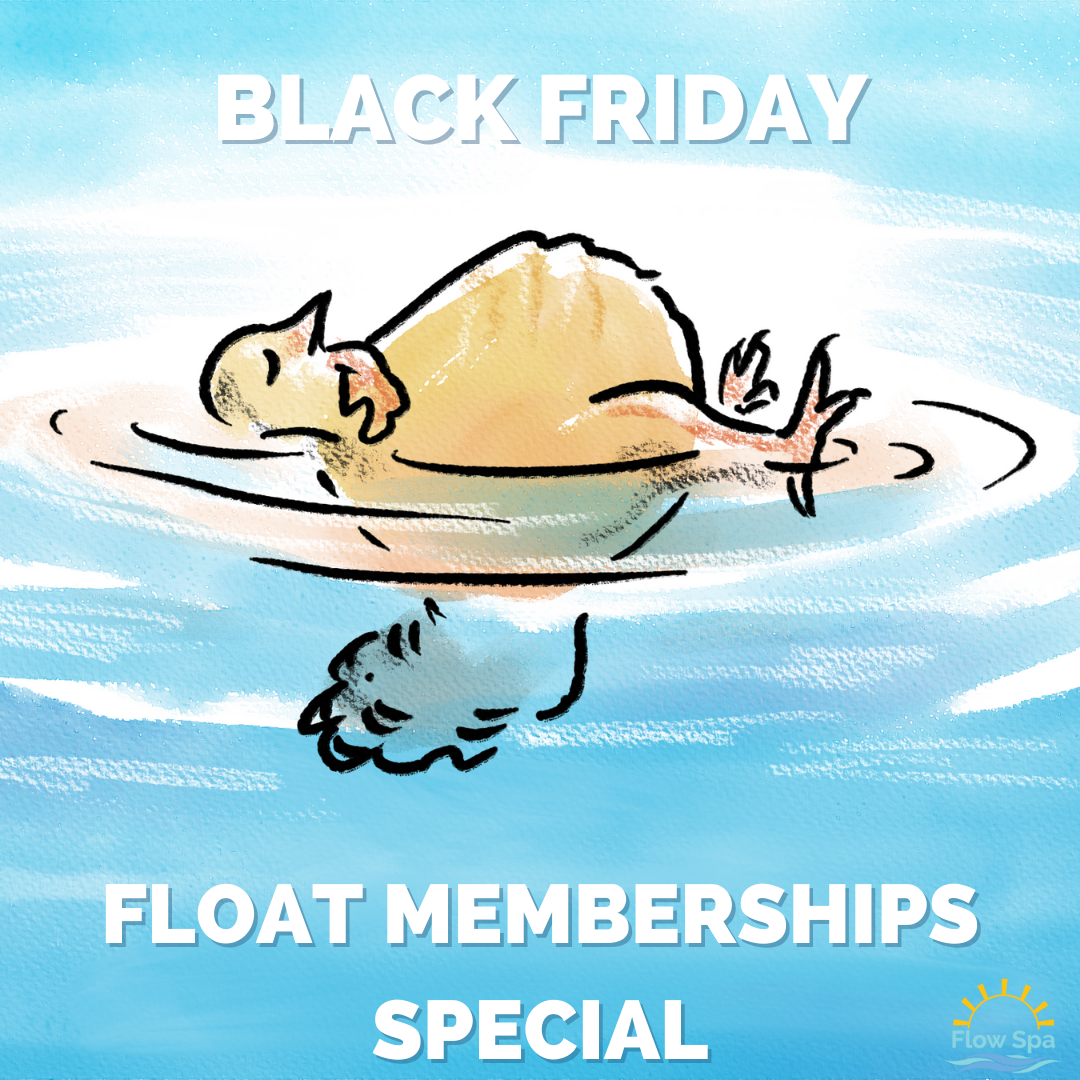
Black Friday Specials 2021
Black Friday Frenzy is upon us (although it seems like it's now a race to whoever can launch their sale earlier in November).
However, I see a lot of us fighting back against the craze and looking to be more thoughtful with supporting small businesses with our spending and gift-giving.
And what we all want most this year is not a shiny new object but is to de-stress.

What we all want most this year is to de-stress.
I see it every day.
This year give them what they need the most, and you've got early access to this special deal. (The links down below are private so don't share them before they go live.)
Friday-Monday only, we've got the following specials on float memberships:
Gift One Month of Basic Membership - $55 (One float credit)
Gift Their First Two Months of a Biweekly Membership - $175 (Four float credits)
For the avid floater or flexible membership, 12 floats for $500 (12 float credits)
Even though there's no expiry on these float credits, you already know that regular floats are one of the best ways to include recovery time in your schedule.
So whether you want to gift yourself with some floats, or spread the joy of floating this holiday season, now's the time.
View all the offers here:
Fight or Flight or Float?... Managing The Stress Response To Your Life
When your threat detection system goes off and your spidey sense starts tingling as the hairs on the back of your neck stand up, how do you respond?
Do you fight or do you flee?
We are all familiar with the feeling that floods in when we become aware of a threat in our surroundings.
Heart rate skyrockets, breathing becomes rapid and shallow, we get that tingling sensation as our blood flows from our core to our limbs to mobilize us for action to escape this threat.
While much less common today, this autonomic response to stress or threats was instilled to protect us from the jaguar hidden in the jungle only given away by the subtle sound of a twig snapping or the need to sprint after the deer to feed your family as it tries to get away.
When our sympathetic nervous system is engaged, we are in full-force action mode to handle anything in our way.
Working opposite to our sympathetic response is the relaxation response known as rest and digest. It helps to keep stress levels in check and takes over when we feel safe and secure. With this parasympathetic activation, our breathing and heart rate slow down and as blood can return to our core, our digestive system becomes more active again and we’re also more likely to be sexually aroused.
There are important functions to both sympathetic and parasympathetic responses in our bodies and we depend on the ability to engage in fight or flight to deal with short-term challenges.
The problem that we face today is that stress has become a constant in our lives. The kids are late for school, then someone cuts you off in traffic, so now you’re running late to get to work and you get chewed out by your boss.
And this is all before 9 am while guzzling down a stimulating pot of coffee.
Our days go by like this constantly and even if we try to stay positive, that threat detection system is used to working subconsciously to protect us.
Even before the booming threat of the pandemic, stress levels were already on the rise, especially in cities where there’s a constant din of noise, motion, and interaction keeping our nervous systems buzzing. Everybody says that they’re stressed and in a constant state of avoiding overwhelm and having to deal with COVID hasn’t helped anyone.
Finding ways to unwind and get our bodies into the relaxation response is one of the best things we can do for our physical and mental health. When the term “relaxation response” was first coined by Herbert Benson, he came up with a protocol for practicing relaxation and eliciting the response.
The original steps for the relaxation response look very similar to a beginner practice of mindfulness and that’s because Dr. Benson is often credited with familiarizing his Western audience with meditation through rebranding it as the “Relaxation Effect.”
Meditation is a tricky thing though because despite rebranding it or rephrasing the concept, most people don’t know how to get started with meditation in a meaningful way that feels like something positive.
But that’s where float tanks come in.
Most people are curious to try out the float experience and to escape from the world in the nearly complete way that only floating can allow for.
It’s not surprising given the many studies that have found floating in a float tank brings on the relaxation effect as well as the benefits that come with that. And this is in part due to how many people describe floating as a sort of training wheels for meditation. It’s like your mental filing cabinet where your brain is able to turn down the noise and sort out the thoughts that tend to swirl around uncontrollably.
People coming in to float notice in real-time the benefits for reducing stress, improving mood, and also helping to increase focus as you return to the outside world.
The float tank environment is the perfect place to turn off that stress response that is ever-present in our lives today. It’s a safe and comfortable space to engage our relaxation response and let go of everything.
Depending on how you like to float, you can completely tune out from all the stimuli that are normally present and keep our fight of flight response actively engaged. You get to choose calming music or blissful silence and the comfort of lights if you don’t want to immerse yourself in complete darkness.
The next time that you feel you're fed up with life and ready to lose it, instead of running away from your problems or getting into an argument, give yourself a time-out to engage your relaxation response. Or even better, treat yourself to a float and relax every muscle in your body while your brain gets to have a complete rest as well.

I Just Had My First Reflexology Appointment
Reflexology In Peterborough
As many of you have already heard, we are excited to introduce reflexology here at Flow Spa in Peterborough.
Heather has been doing her training in reflexology and holistic reproductive practices.
As a avid float member here at Flow Spa, when she reached out to me about partnering up to offer another service to help us all combat stress and relax deeply, I couldn’t wait to hear more.
We all know that people who float regularly have the best ideas!
So there I was, the first on board to get my feet treated by Heather this week.
The Best Foot Massage Ever
I was a little bit nervous about how it would go. Not that I don’t know how to relax well, but I’m very ticklish and my feet were about to be centre stage.
But as I sat down and lay back in the recliner, which is my favourite chair in the whole world, the pressure used for reflexology treatments was no issue for my sensitive feet.
Tension melted away and I felt super relaxed. The room set up works perfectly for these appointments and everyone has been really happy and feeling great with Heather so far.
The treatment is so relaxing that many of Heather’s clients fall asleep.
My feet and whole body were definitely thankful for this relaxing experience.
As a strongman competitor and ramping up my training, my feet bear a lot and take a beating all the time.
You’re going to love it!